
In today’s fast-changing tech industry, companies are constantly searching for developers who can build modern and scalable web applications from start to finish. That’s why the demand for MERN Stack Developers is growing rapidly across startups and tech companies.
However, for beginners, the journey often feels confusing. With countless tutorials, frameworks, and learning resources available online, many aspiring developers struggle to understand where to begin and what skills actually matter.
As a result, people often waste months learning random topics without building real-world experience. This can slow progress and make the learning process frustrating.
In this guide on how to become a MERN Stack developer, you will learn the right steps, required skills, and practical tips to confidently start your journey.
What is MERN Stack?
MERN Stack is a popular full-stack development approach that uses four technologies to build modern web applications. It allows developers to use JavaScript for both frontend and backend, making development simple and efficient.
MERN stands for MongoDB, Express, React, and Node.js. These technologies work together to create fast, scalable, and dynamic applications. MongoDB handles data storage, Express and Node.js manage the server, and React builds the user interface, helping developers easily create complete web solutions.
Why Choose MERN Stack in 2026?
The MERN Stack remains one of the best choices for developers in 2026 due to its flexibility, high demand, and strong ecosystem. Below are the key reasons to choose the MERN Stack:
1. High Demand in the Job Market
MERN Stack developers are in high demand as companies prefer full-stack developers who can handle both frontend and backend development. Startups and tech companies look for developers who can build complete applications, making MERN skills valuable for better job opportunities and career growth.
2. Single Language Development
One of the biggest advantages of MERN Stack is that it uses JavaScript for both frontend and backend. This makes learning easier and faster for beginners, while also improving productivity by reducing the need to switch between different languages.
3. Strong Community Support
MERN Stack technologies have a large and active community. Developers can easily find tutorials, documentation, and solutions to problems online. This support helps beginners learn quickly and solve issues without getting stuck, making the learning journey smoother and more efficient.
4. Scalable and Flexible Applications
MERN Stack allows developers to build scalable and flexible web applications. It is suitable for both small projects and large-scale applications. With tools like MongoDB and Node.js, developers can handle growing data and traffic efficiently without affecting performance.
5. Better Career Growth Opportunities
Learning MERN Stack opens doors to multiple career roles such as frontend developer, backend developer, and full-stack developer. It provides strong practical skills that are useful in real-world projects, helping developers grow faster and build a successful career in web development.
Also Read: MERN Stack Course Syllabus (Updated Curriculum)
MERN Stack Components
Below are the main components discussed in detail:
1. MongoDB
MongoDB is a NoSQL database used to store application data in a flexible, JSON-like format. It allows developers to handle large amounts of data easily and scale applications when needed. Its document-based structure works smoothly with JavaScript, making data handling faster and more efficient.
2. Express.js
Express.js is a lightweight backend framework used with Node.js to build web applications and APIs. It simplifies server-side development by handling routing, requests, and middleware. Developers use Express to create secure and structured backend systems, making it easier to manage application logic and connect with databases.
3. React.js
React.js is a popular frontend library used to build interactive and user-friendly interfaces. It allows developers to create reusable components, making development faster and more organized. With its fast rendering and efficient updates, React helps improve user experience and performance in modern web applications.
4. Node.js
Node.js is a runtime environment that allows JavaScript to run on the server side. It is used to build fast and scalable backend services. With its non blocking architecture, Node.js can handle multiple requests efficiently, making it ideal for real-time applications and high-performance web development.
Recommended Professional
Certificates
Skills Required to Become a MERN Stack Developer
To become a MERN Stack developer, you need strong technical knowledge and practical skills to build complete web applications. Below are the essential technical skills required:
Technical Skills
- HTML and CSS: HTML structures web pages and CSS styles them for better appearance. Together, they help you create layouts, design responsive interfaces, and improve the overall user experience across different devices.
- JavaScript: JS is the core language of the MERN Stack, used in both frontend and backend. It helps build interactive features, handle application logic, and connect different parts of an application.
- React.js: React.js is used to build dynamic and interactive user interfaces. It allows developers to create reusable components, manage application state, and improve performance with efficient rendering techniques.
- Node.js: Node.js is a runtime environment that allows JavaScript to run on servers. It is used to build fast, scalable backend systems and handle multiple user requests efficiently.
- Express.js: Simplifies backend development by managing routes, handling requests, and building secure APIs for smooth frontend and backend communication.
- MongoDB: A NoSQL database for storing application data in a flexible format. It supports scalability and works well with JavaScript-based applications in the MERN Stack.
- Version Control: Git and GitHub are used for version control and code management. They help track changes, collaborate with other developers, and efficiently maintain project history.
- REST APIs: Allow communication between frontend and backend systems. They help send and receive data, making it possible to connect user interfaces with server-side functionality.
- Basic Data Structures and Algorithms: DSA knowledge improves problem-solving skills and coding efficiency. It helps developers write optimized code, handle complex logic, and perform better in technical interviews.
Soft Skills
- Communication Skills: Clear communication helps you explain ideas, discuss requirements, and collaborate effectively with team members. It also improves your ability to work with clients and to properly understand project needs.
- Problem Solving: Strong problem-solving skills help you identify errors, debug issues, and find efficient solutions. This is important when building applications and handling real-world development challenges.
- Time Management: Helps you complete tasks on schedule and stay productive. It is important for meeting deadlines, balancing multiple tasks, and maintaining consistency in your learning and projects.
- Teamwork: Working with developers, designers, and stakeholders helps you share ideas, solve problems together, and build better applications efficiently.
- Adaptability: Technology changes quickly, so being adaptable helps you learn new tools and frameworks. It allows you to stay up to date and continue growing in your development career.
- Attention to Detail: Helps you write clean code, avoid errors, and improve application quality, ensuring better performance and user experience.
Suggested Reading: MERN Stack Developer Salary in India
How to Become a MERN Stack Developer? (Step-by-Step)
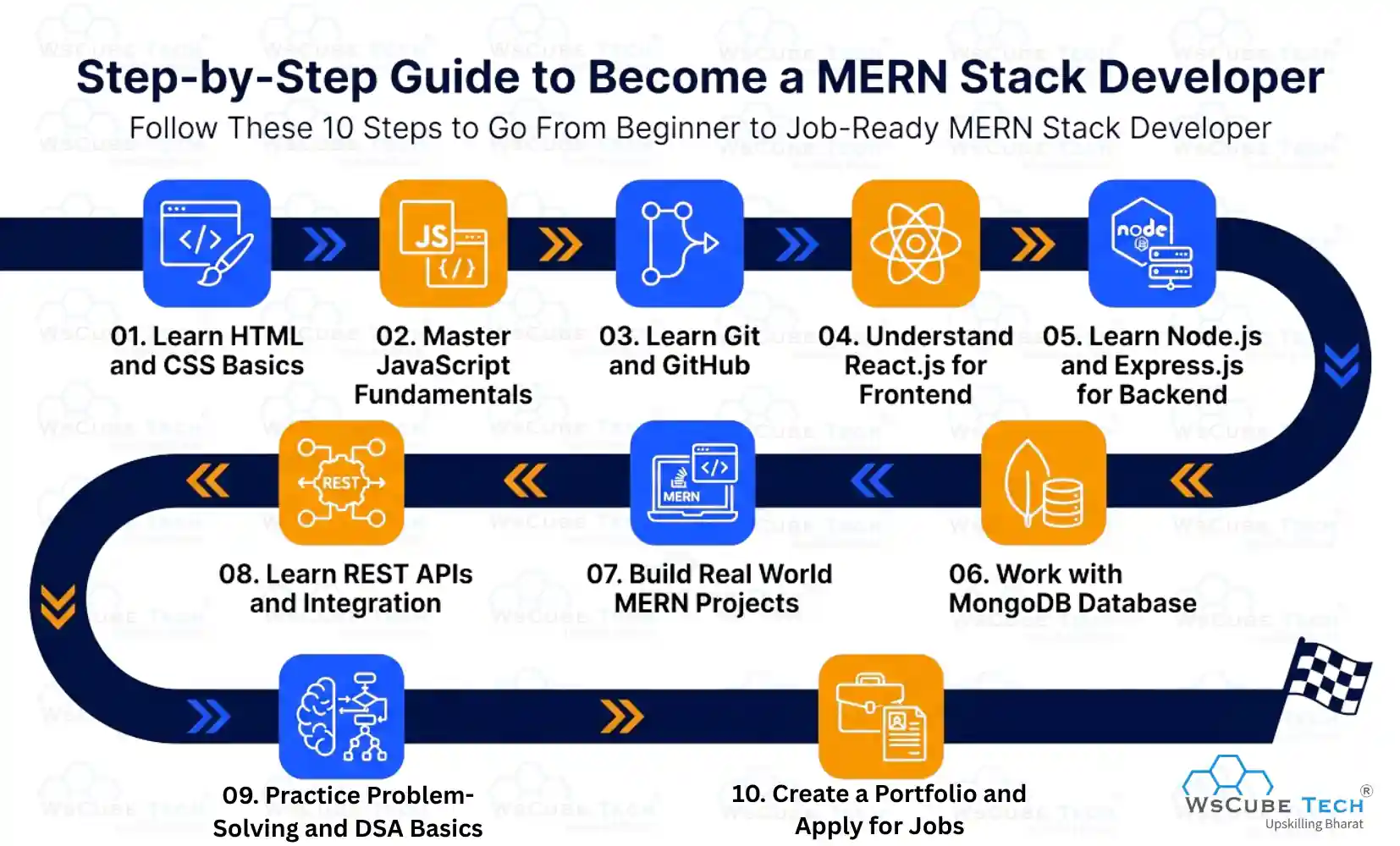
Here is the MERN Stack developer roadmap that you can follow step by step to build strong skills and become job-ready:
- Step 1: Learn HTML and CSS basics
- Step 2: Master JavaScript fundamentals
- Step 3: Learn Git and GitHub
- Step 4: Understand React.js for frontend
- Step 5: Learn Node.js and Express.js for backend
- Step 6: Work with MongoDB database
- Step 7: Build real world MERN projects
- Step 8: Learn REST APIs and integration
- Step 9: Practice problem-solving and DSA basics
- Step 10: Create a portfolio and apply for jobs
Below, we will explore each step in detail to help you follow a clear and structured learning path.
Step 1: Learn HTML and CSS basics
Learning HTML and CSS is the first step to becoming a MERN Stack developer, as it helps you understand how web pages are structured and styled from scratch. Here are the key concepts you should focus on:
- HTML (HyperText Markup Language): Learn to structure web pages using elements like headings, paragraphs, links, images, and forms to create a clear and organized layout.
- CSS (Cascading Style Sheets): Learn how to style web pages using colors, fonts, spacing, layouts, and simple animations to make your website visually appealing and easy to use.
- Responsive Design: Understand how to make websites adapt to different screen sizes using media queries and flexible layouts for mobile, tablet, and desktop users.
- Flexbox and Grid: Learn modern layout techniques like Flexbox and Grid to design clean, flexible, and well-structured web page layouts efficiently.
- Basic Projects: Practice by building simple projects like landing pages, portfolios, or forms to strengthen your understanding and gain practical experience.
Building a strong foundation in HTML and CSS will make it easier to move toward JavaScript and advanced frontend technologies.
Step 2: Master JavaScript Fundamentals
JavaScript is the core of the MERN Stack, so mastering its fundamentals is essential to building interactive and dynamic web applications. Here are the key concepts you should focus on:
- Basic Concepts: Learn variables, data types, operators, and control structures like if-else and loops to understand how JavaScript works.
- Functions and Scope: Understand functions, parameters, return values, and scope to write reusable and organized code.
- DOM Manipulation: Learn how to interact with web pages by selecting elements, updating content, and handling events like clicks and inputs.
- ES6 Features: Explore modern features like arrow functions, destructuring, spread operator, and modules to write cleaner and efficient code.
- Asynchronous JavaScript: Learn promises, async await, and callbacks to handle API calls and asynchronous operations effectively.
- Practice Projects: Build small projects such as a to-do list, a calculator, or form validation to strengthen your understanding.
Mastering JavaScript fundamentals will make it easier to learn React, Node.js, and other advanced concepts in the MERN Stack.
Step 3: Learn Git and GitHub
Git and GitHub are essential tools for version control and collaboration. They help you manage code, track changes, and work efficiently on projects. Below are the key concepts you should focus on:
- Git Basics: Learn commands like init, add, commit, status, and log to track and manage your code changes locally.
- Repositories: Understand how to create and manage local and remote repositories to store and organize your projects.
- Branching and Merging: Learn to create branches, work on features, and merge them without affecting the main project code.
- GitHub Usage: Learn to push code, create repositories, and share your projects online for collaboration and visibility.
- Collaboration Workflow: Understand pull requests, code reviews, and issue tracking to work effectively in team environments.
- Project Management: Use GitHub to maintain project history, track progress, and showcase your work to recruiters.
Learning Git and GitHub will help you manage projects professionally and collaborate with other developers easily.
Step 4: Understand React.js for frontend
React.js is used to build modern and interactive user interfaces. It helps you create fast and dynamic web applications using reusable components. Here are the key concepts you should learn:
- Components: Learn how to create reusable components to organize your code and build scalable user interfaces efficiently.
- JSX: Understand JSX syntax to write HTML like code inside JavaScript for building UI elements.
- Props and State: Learn how to pass data using props and manage dynamic data using state in your applications.
- Event Handling: Handle user interactions like clicks, inputs, and form submissions to make applications interactive.
- Hooks: Learn the basics of hooks like useState and useEffect to manage state and side effects in functional components.
- Routing: Understand how to use React Router to navigate between different pages in a single-page application.
- Projects Practice: Build small projects, like to-do apps or dashboards, to strengthen your understanding.
Learning React.js will help you build powerful frontend applications and improve user experience in your MERN Stack projects.
Step 5: Learn Node.js and Express.js for Backend
Node.js and Express.js help you build the backend of web applications, handle server logic, and manage data communication between frontend and database. The following are the main areas to learn:
- Node.js Basics: Learn how to run JavaScript on the server, handle modules, and work with file systems and basic server setup.
- Express.js Framework: Understand routing, middleware, and how to build simple and structured backend applications using Express.
- API Development: Learn to create REST APIs to handle requests and responses between frontend and backend.
- Middleware Usage: Understand how middleware works for authentication, logging, and request handling in applications.
- Error Handling: Learn to manage errors properly to make your application stable and reliable.
- Backend Projects: Build simple projects like APIs or basic servers to practice backend development.
Mastering Node.js and Express.js will help you build strong backend systems and connect your application with databases like MongoDB.